If you want to attract more customers online, this Meta Ads Guide will help you understand everything from creating your first campaign to using artificial intelligence for better performance. Today, Meta Ads have become one of the most effective advertising solutions for businesses because they allow brands to reach the right audience across Facebook, Instagram, Messenger, and the Audience Network. Moreover, Meta continues to introduce AI-powered tools that simplify campaign management, improve targeting, and maximize return on investment. Whether you own a startup, an eCommerce store, or an established company, learning how Meta Ads work can help you generate qualified leads, increase sales, and build long-term business growth.
Digital advertising has changed dramatically over the last few years. Businesses no longer rely only on traditional advertising because customers spend hours every day on social media platforms like FaceBook, Instagram, YouTube, Snapchat and Tik-Tok. As a result, companies are investing in advertising platforms like Google Ads, Meta Ads, Snapchat Ads, and more. Among them, Meta Ads is one of the most popular because it gives businesses access to billions of active users worldwide.
Furthermore, modern businesses combine digital marketing services, search engine optimization, Google Ads, and Meta Ads to build a complete marketing strategy. While SEO delivers long-term organic traffic, Meta Ads generate immediate visibility and help businesses reach highly targeted audiences.
What Are Meta Ads?
Meta Ads are paid advertisements that run across Meta’s platforms, including:
Before launching your first campaign, this Meta Ads Guide explains the fundamentals every advertiser should understand.
Unlike traditional advertising, Meta Ads allow advertisers to target people based on demographics, interests, behaviors, purchase history, locations, and even online activity.
For example, if you own a fitness brand, you can target users who:
- Follow fitness pages
- Visit gym websites
- Purchase workout equipment
- Watch fitness videos
- Engage with health-related content
As a result, your advertising budget reaches people who are more likely to become customers.
Why Businesses Choose Meta Ads
This Meta Ads Guide shows why businesses continue to invest in Meta’s advertising ecosystem for measurable growth. Businesses of every size use Meta Ads because they provide measurable and scalable marketing opportunities.
Some of the biggest advantages include:
- Advanced audience targeting
- AI-powered campaign optimization
- Multiple campaign objectives
- Affordable advertising budgets
- Real-time performance tracking
- High-quality lead generation
- Increased brand awareness
- Better customer engagement
Moreover, Meta Ads work well alongside SEO services and Google Ads, creating a balanced digital marketing strategy that captures customers at different stages of the buying journey.
How the Meta Advertising Ecosystem Works
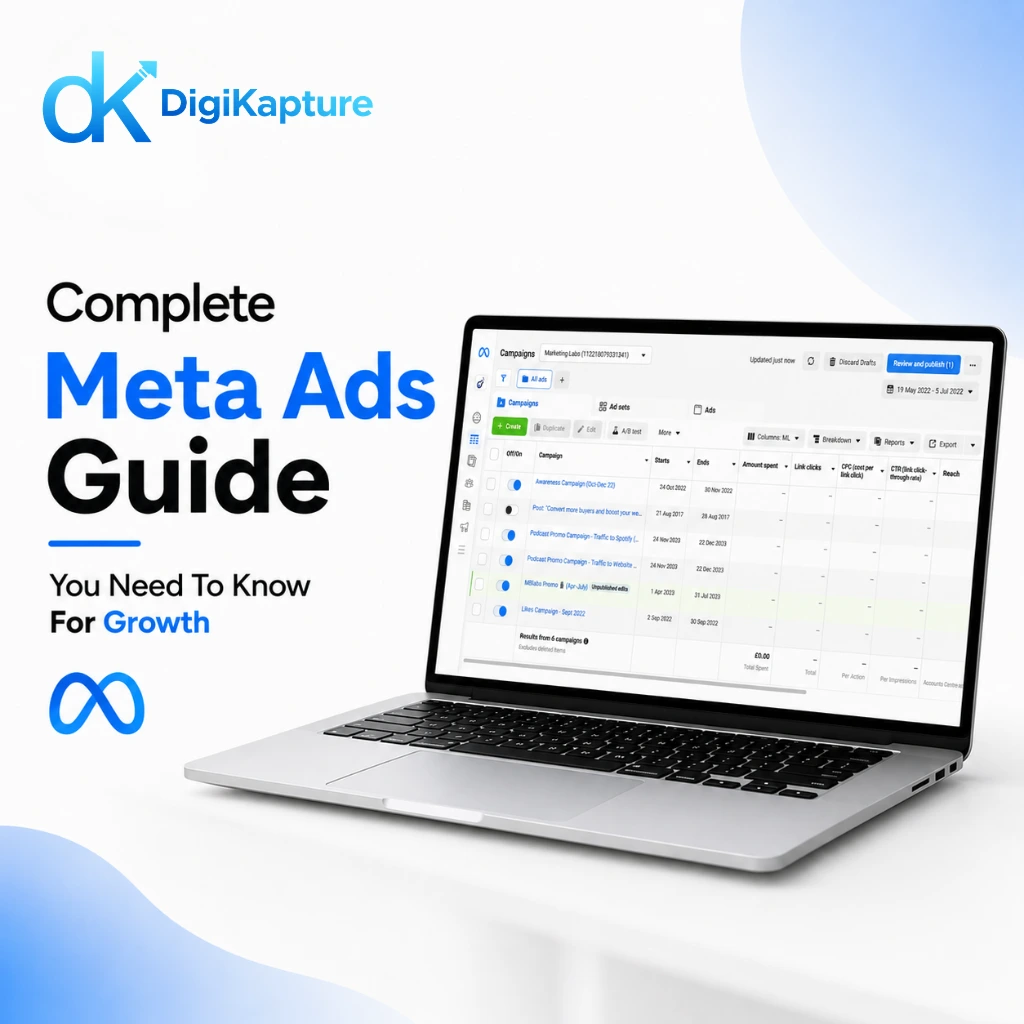
Meta Ads operate through Meta Ads Manager, where advertisers create campaigns, manage budgets, monitor performance, and optimize results.
Every campaign follows three simple levels:
Campaign
The campaign defines your marketing objective.
Common objectives include:
- Brand Awareness
- Traffic
- Engagement
- Leads
- Sales
- App Promotion
Choosing the correct objective helps Meta’s AI optimize your campaign more effectively.
Ad Set
The Ad Set in which you can control:
- Audience targeting
- Budget
- Placements
- Schedule
- Optimization goals
This is where most of your campaign strategy is built.
Advertisement
The advertisement is the most crucial part of a Meta Ad because it is what your audience sees and interacts with. A well-designed ad can capture attention, communicate your message, and encourage users to take action. It typically includes:
- Images
- Videos
- Carousel creatives
- Headlines
- Primary text
- Call-to-action (CTA) buttons
The quality of your creative often determines whether users click or continue scrolling.
Understanding AI in Meta Ads
A complete Meta Ads Guide should also explain how artificial intelligence improves campaign performance and automation.
Artificial Intelligence (AI) has transformed how Meta Ads work by automating many campaign optimization tasks. However, if you’re just getting started with Meta Ads, it’s better to avoid relying entirely on AI-powered or highly automated campaign options.
When you choose advanced AI-driven campaign settings, Meta takes over much of the optimization process. It automatically decides who should see your ads based on its machine learning models. While this can improve performance, it also gives you less control over important targeting options such as:
- Age groups
- Gender
- Devices
- Demographics
- Interests
- Behaviors
- Placements
- Audience targeting
For beginners, manually setting up your campaigns is the best way to understand how Meta Ads works. Once you gain experience and know which audiences perform best, you can start using Meta’s AI features to automate and scale your campaigns more effectively.
AI Features That Make Meta Ads Smarter
In this Meta Ads Guide we have also introduced several AI-powered features that help advertisers improve campaign performance with less manual effort.
Advantage+ Campaigns
Advantage+ Campaigns automate audience selection, placements, bidding strategies, and campaign optimization.
Instead of creating dozens of audience segments manually, advertisers can let AI identify the highest-converting users.
This saves time while often improving campaign performance.
Advantage+ Audience
Rather than restricting campaigns to narrow audiences, Meta AI expands targeting when it identifies users who are likely to convert.
As a result, campaigns reach more qualified customers without sacrificing relevance.
Advantage+ Placements
Instead of choosing Facebook or Instagram manually, Meta automatically places advertisements where they are most likely to perform.
This improves efficiency while reducing advertising costs.
AI Creative Optimization
Meta automatically adjusts:
- Image formats
- Text placement
- Brightness
- Aspect ratios
- Call-to-action presentation
Therefore, advertisers can deliver better-performing ads across multiple devices without creating separate creatives for every placement.
Benefits of AI in Meta Ads
Artificial intelligence offers several advantages for businesses running Meta Ads.
Some of the biggest benefits include:
- Faster campaign optimization
- Improved audience targeting
- Lower cost per conversion
- Better budget allocation
- Higher return on ad spend (ROAS)
- Automatic learning from campaign data
- Real-time performance improvements
- Less manual campaign management
Furthermore, businesses can spend more time focusing on strategy while AI handles repetitive optimization tasks.
Where Meta Ads Fit Into Your Marketing Strategy
Meta Ads work best when combined with other marketing channels rather than operating alone.
For example:
- Search engine optimization attracts long-term organic visitors.
- Google Ads capture users actively searching for products or services.
- Meta Ads create demand by reaching users before they search.
- Email marketing nurtures existing customers.
- Content marketing builds trust and authority.
Similarly, businesses that invest in custom web design and professional web development services often achieve better advertising results because optimized landing pages increase conversion rates.
Even the best advertising campaign may struggle if visitors land on a slow or poorly designed website. That is why many companies work with a trusted web development agency to ensure their website delivers a seamless user experience before increasing their advertising budget.
How to Create a Meta Ads Campaign Step by Step
Follow this Meta Ads Guide step by step to create campaigns that align with your business goals.
Creating a successful Meta Ads campaign involves much more than choosing an image and clicking the publish button. Every campaign should have a clear objective, the right audience, engaging creatives, and continuous optimization. Fortunately, Meta Ads Manager provides all the tools needed to manage your campaigns effectively.
Step 1: Create a Meta Business Account
Before running advertisements, create a Meta Business Account through Meta Business Suite. This platform allows you to manage your Facebook Page, Instagram account, advertising assets, payment methods, and team members from one place.
A Business Account also improves security and provides access to advanced advertising features.
Step 2: Open Meta Ads Manager
Meta Ads Manager is the control center for every campaign. Here, you can:
- Create campaigns
- Manage audiences
- Track conversions
- Monitor ad performance
- Adjust budgets
- Review campaign reports
Instead of managing ads manually on Facebook or Instagram, Ads Manager gives you complete control over every aspect of your advertising strategy.
Step 3: Choose the Right Campaign Objective
Selecting the correct objective is one of the most important decisions because Meta’s AI optimizes your campaign based on this choice.
The available campaign objectives include:
Awareness
This objective helps introduce your brand to new audiences and increase visibility.
Best for:
- New businesses
- Brand launches
- Product awareness
Traffic
Traffic campaigns encourage users to visit your website, landing page, or mobile application.
Ideal when you want more visitors before focusing on conversions.
Engagement
Engagement campaigns encourage people to:
- Like posts
- Comment
- Share content
- Watch videos
- Follow your page
These campaigns are excellent for building trust and social proof.
Leads
Lead campaigns collect customer information without requiring users to leave Facebook or Instagram.
Businesses commonly collect:
- Names
- Email addresses
- Phone numbers
- Appointment requests
- Consultation bookings
Many marketing agencies use Lead Ads because they reduce friction and improve conversion rates.
Sales
Sales campaigns focus on purchases, bookings, subscriptions, or other valuable conversions.
This objective works best for businesses with an active website and properly configured tracking.
Understanding Your Audience
In this Meta Ads Guide you also know that one of the biggest reasons businesses choose Meta Ads is its advanced audience targeting capabilities.
Instead of advertising to everyone, you can reach people who are genuinely interested in your products or services.
Core Audiences
Core audiences allow advertisers to target users based on:
- Age
- Gender
- Language
- City
- State
- Country
- Interests
- Behaviors
- Education
- Job titles
For example, a company offering web development services can target:
- Business owners
- Startup founders
- Entrepreneurs
- eCommerce brands
- Technology enthusiasts
This approach increases relevance and improves campaign performance.
Custom Audiences
Custom Audiences allow businesses to reconnect with people who already know their brand.
These audiences may include:
- Website visitors
- Previous customers
- Email subscribers
- App users
- Facebook Page visitors
- Instagram profile visitors
- Video viewers
Retargeting these audiences often produces higher conversion rates because users have already interacted with your business.
Lookalike Audiences
Meta’s AI can identify new users who share similar characteristics with your existing customers.
For example, if your customer list contains 5,000 buyers, Meta analyzes their behaviors and finds millions of similar users.
As a result, businesses can expand their reach while maintaining audience quality.
Budgeting Your Meta Ads
Every Meta Ads Guide should emphasize that smart budgeting is more important than simply spending more money. One common misconception is that businesses need thousands of dollars to succeed with Meta Ads. In reality, campaigns can perform well even with modest budgets when they are managed correctly.
Daily Budget
A daily budget tells Meta how much you want to spend each day.
For example:
- $20 per day
- $50 per day
- $100 per day
Meta automatically distributes your budget throughout the day to maximize results.
Lifetime Budget
A lifetime budget defines the total amount you want to spend during the campaign.
This option works well for:
- Seasonal promotions
- Product launches
- Holiday campaigns
- Limited-time offers
Choosing the Right Bidding Strategy
Meta offers automated bidding powered by AI. For most businesses, automatic bidding is the best option because it continuously adjusts bids based on competition and conversion opportunities.
Experienced advertisers may choose manual bidding when they have enough historical data to support their strategy.
Meta Pixel and Conversion API
Running advertisements without tracking conversions is like driving without a dashboard.
To measure campaign success accurately, businesses should install the Meta Pixel and configure the Conversion API.
What Is Meta Pixel?
Meta Pixel is a small piece of code added to your website.
It tracks important user actions such as:
- Page views
- Product views
- Add-to-cart events
- Purchases
- Form submissions
- Contact requests
This information helps Meta’s AI understand which users are most likely to convert.
What Is Conversion API?
As privacy regulations continue to evolve, browser-based tracking has become less reliable.
Conversion API solves this challenge by sending conversion data directly from your server to Meta.
Benefits include:
- More accurate reporting
- Better attribution
- Improved campaign optimization
- Higher-quality audience data
Businesses investing in custom web design and professional web development services should configure both Pixel and Conversion API to maximize campaign performance.
Facebook Ads vs Meta Ads
Many people still use the term Facebook Ads, but Meta Ads now cover multiple platforms under one advertising system.
| Facebook Ads | Meta Ads |
| Facebook only | Facebook, Instagram, Messenger, Audience Network |
| Limited ecosystem | Complete advertising platform |
| Traditional targeting | AI-powered targeting |
| Manual optimization | Automated optimization features |
| Smaller reach | Billions of users worldwide |
Although Facebook remains a major platform, Meta Ads provide advertisers with significantly broader reach and smarter automation.
Best Practices for High-Performing Meta Ads
This Meta Ads Guide encourages continuous testing because optimization never stops in digital advertising. Even the most advanced AI cannot fix a weak advertising strategy. Therefore, businesses should follow proven best practices to maximize campaign performance.
Write Clear Ad Copy
Your message should communicate value immediately.
Instead of focusing only on features, explain how your product or service solves a problem.
Use High-Quality Creatives
Visual content has a direct impact on user engagement.
Use:
- Professional images
- High-resolution videos
- Authentic customer content
- Strong branding
- Clear call-to-action buttons
Test Multiple Creatives
Never rely on a single advertisement.
Instead, test:
- Headlines
- Images
- Videos
- Primary text
- CTA buttons
A/B testing helps identify which combinations generate the best results.
Optimize Your Landing Pages
An excellent advertisement can still fail if visitors land on a slow or confusing website.
Before increasing your advertising budget, ensure your website:
- Loads quickly
- Is mobile responsive
- Has clear navigation
- Includes persuasive calls to action
- Builds trust with testimonials and reviews
Many businesses combine Meta Ads with SEO services and a professional web development agency to create a complete digital growth strategy that converts visitors into customers.
Where Meta Ads Fit Within Digital Marketing
Meta Ads should not operate in isolation. Instead, they perform best when integrated with other digital marketing services.
For example:
- Search engine optimization builds long-term organic visibility.
- Google Ads capture users with high purchase intent.
- Meta Ads create awareness and generate demand before customers begin searching.
- Email marketing nurtures leads until they are ready to buy.
- Content marketing establishes authority and trust.
This integrated approach enables businesses to attract, engage, and convert customers throughout every stage of the buying journey. It also explains why successful companies often partner with experienced marketing agencies that understand how different marketing channels work together rather than relying on a single advertising platform.
Common Meta Ads Mistakes That Cost Businesses Money
Even though Meta Ads provide powerful advertising capabilities, many businesses fail to achieve their desired results because of avoidable mistakes. Fortunately, identifying these issues early can save both time and advertising budget.
Targeting an Audience That Is Too Broad
Many advertisers believe that reaching more people automatically produces better results. However, showing your ads to users who have little interest in your products or services usually increases costs while reducing conversions.
Instead, build audiences based on customer interests, behaviors, demographics, website visitors, and lookalike audiences. This approach allows Meta’s AI to find users who are more likely to become paying customers.
Ignoring Creative Fatigue
People see thousands of advertisements every day. Consequently, repeatedly showing the same creative reduces engagement over time.
Refresh your campaigns regularly by testing:
- New headlines
- Different images
- Short-form videos
- User-generated content
- Updated offers
- Stronger calls to action
Small creative improvements can significantly increase campaign performance.
Not Tracking Conversions Properly
Many businesses only monitor clicks or impressions in their ads. Although these metrics provide useful insights, they do not reveal whether your campaigns generate actual business results.
Instead, focus on meaningful metrics such as:
- Cost Per Lead (CPL)
- Cost Per Purchase (CPP)
- Return on Ad Spend (ROAS)
- Conversion Rate
- Customer Acquisition Cost (CAC)
- Lifetime Customer Value (LTV)
These metrics provide a much clearer picture of campaign success.
Sending Traffic to Poor Landing Pages
An excellent advertisement cannot compensate for a slow or confusing website.
Your landing page should:
- Load in just a few seconds.
- Match the advertisement’s message.
- Be fully responsive on mobile devices.
- Include a clear call-to-action.
- Build trust through reviews, testimonials, certifications, or case studies.
Businesses that invest in professional custom web design and web development services often achieve higher conversion rates because visitors enjoy a smoother user experience.
Stopping Campaigns Too Early
Meta’s AI requires time to learn from campaign data. Unfortunately, many advertisers stop campaigns after only a few days because they expect immediate results.
Instead, allow campaigns to complete the learning phase before making major changes. Stable data helps Meta optimize delivery more effectively and often leads to stronger long-term performance.
The Future of AI in Meta Ads
Artificial intelligence is no longer an optional feature-it is becoming the foundation of digital advertising. Every major update from Meta introduces smarter automation, predictive analytics, and advanced machine learning that reduce manual work while improving campaign performance.
In the coming years, businesses can expect AI to automate even more aspects of advertising, including:
- Audience discovery
- Creative generation
- Budget allocation
- Bid optimization
- Performance forecasting
- Customer journey analysis
- Personalized ad experiences
Additionally, generative AI will continue transforming how businesses create advertising content. Instead of producing multiple versions of an ad manually, advertisers will be able to generate high-quality images, videos, headlines, and primary text in minutes.
However, while AI improves efficiency, human strategy remains essential. Successful campaigns still depend on understanding customer needs, creating compelling offers, and delivering valuable experiences.
The businesses that combine AI-powered automation with strategic decision-making will remain ahead of their competitors.
Why Partnering with the Right Marketing Agency Matters
In this Meta Ads Guide we all tell you that running successful Meta Ads involves much more than launching a campaign. Businesses must understand audience research, creative strategy, conversion tracking, landing page optimization, and ongoing performance analysis.
This is why many companies choose experienced marketing agencies that offer complete digital marketing services rather than relying on advertising alone.
A full-service agency can help businesses combine:
- Meta Ads
- Google Ads
- Search Engine Optimization
- SEO services
- Web development services
- Custom web design
- Analytics and conversion tracking
- Content marketing
This integrated approach creates a stronger online presence and supports sustainable business growth.
For example, reviewing real digital marketing case studies often reveals that businesses achieve the best results when SEO, paid advertising, website optimization, and content marketing work together instead of operating independently.
Choosing the right digital partner matters more than most businesses realize. Whether you’re establishing your presence for the first time or expanding into new markets, working with an agency that has expertise across multiple channels — rather than juggling separate vendors for each — can make a measurable difference to your return on investment.
The advantage of an integrated approach is consistency. When website design, e-commerce setup, PPC, SEO, and social media all sit under one roof, the strategy stays aligned. Your search efforts support your ad campaigns, your social presence reinforces your brand, and nothing works in isolation. Agencies like DigiKapture are built around this model, handling the full spread of digital marketing so that business owners can stay focused on what they do best – running and growing the company – instead of stretching themselves thin across half a dozen marketing tasks.
That’s often the real benefit: not just the individual services, but the freedom that comes from knowing the marketing side is being handled coherently.
If you’ve followed this Meta Ads Guide, you now understand how to build stronger campaigns using AI and data-driven strategies.
Frequently Asked Questions
1. What are Meta Ads?
Meta Ads are paid advertisements that appear across Facebook, Instagram, Messenger, and the Audience Network. Businesses use them to increase brand awareness, generate leads, drive website traffic, and boost online sales.
2. Is Meta Ads better than Google Ads?
Neither platform is universally better. Meta Ads excel at creating demand and reaching highly targeted audiences based on interests and behaviors, while Google Ads capture users who are actively searching for products or services. Many businesses achieve the strongest results by using both platforms together.
3. Can AI improve Meta Ads performance?
Yes. Meta’s AI analyzes user behavior, optimizes audience targeting, manages bidding strategies, recommends placements, and improves campaign delivery. As a result, advertisers often experience lower costs and better conversion rates when campaigns are properly configured.
4. How much should I spend on Meta Ads?
Your budget depends on your business goals, industry, competition, and target audience. Many businesses begin with a modest daily budget to gather performance data before gradually increasing spending on campaigns that consistently deliver strong results.
5. Are Meta Ads suitable for small and large businesses?
Yes. Meta Ads are highly scalable, making them suitable for startups, local businesses, eCommerce brands, and large enterprises alike. The platform offers flexible budgeting and advanced targeting options that can support businesses at every stage of growth.
Driving Smarter Growth with Meta Ads
Building successful advertising campaigns requires more than simply creating an ad and increasing your budget. This Meta Ads Guide has shown that successful advertising depends on strategy, AI, audience research, and continuous optimization. long-term success comes from combining strategic planning, AI-powered automation, audience insights, compelling creatives, accurate conversion tracking, and continuous optimization.
Businesses that understand how Meta’s advertising ecosystem works can reach highly relevant audiences, generate qualified leads, and improve their return on advertising spend. At the same time, integrating Meta Ads with SEO services, search engine optimization, Google Ads, professional web development services, and custom web design creates a stronger digital marketing foundation that supports consistent business growth.
Artificial intelligence has also changed the way campaigns are managed. Features such as Advantage+ Campaigns, AI-powered audience optimization, automated bidding, and creative enhancements help advertisers make smarter decisions while reducing manual effort. However, technology alone cannot replace a well-defined marketing strategy. Businesses that combine AI with thoughtful planning, continuous testing, and data-driven optimization will continue to outperform competitors.
Whether you are launching your first campaign or refining an existing advertising strategy, the principles covered in this guide provide a practical framework for improving campaign performance and achieving measurable results. By applying these best practices consistently and adapting to new innovations, your business will be well-positioned to maximize the full potential of Meta Ads and drive sustainable growth in an increasingly competitive digital landscape.