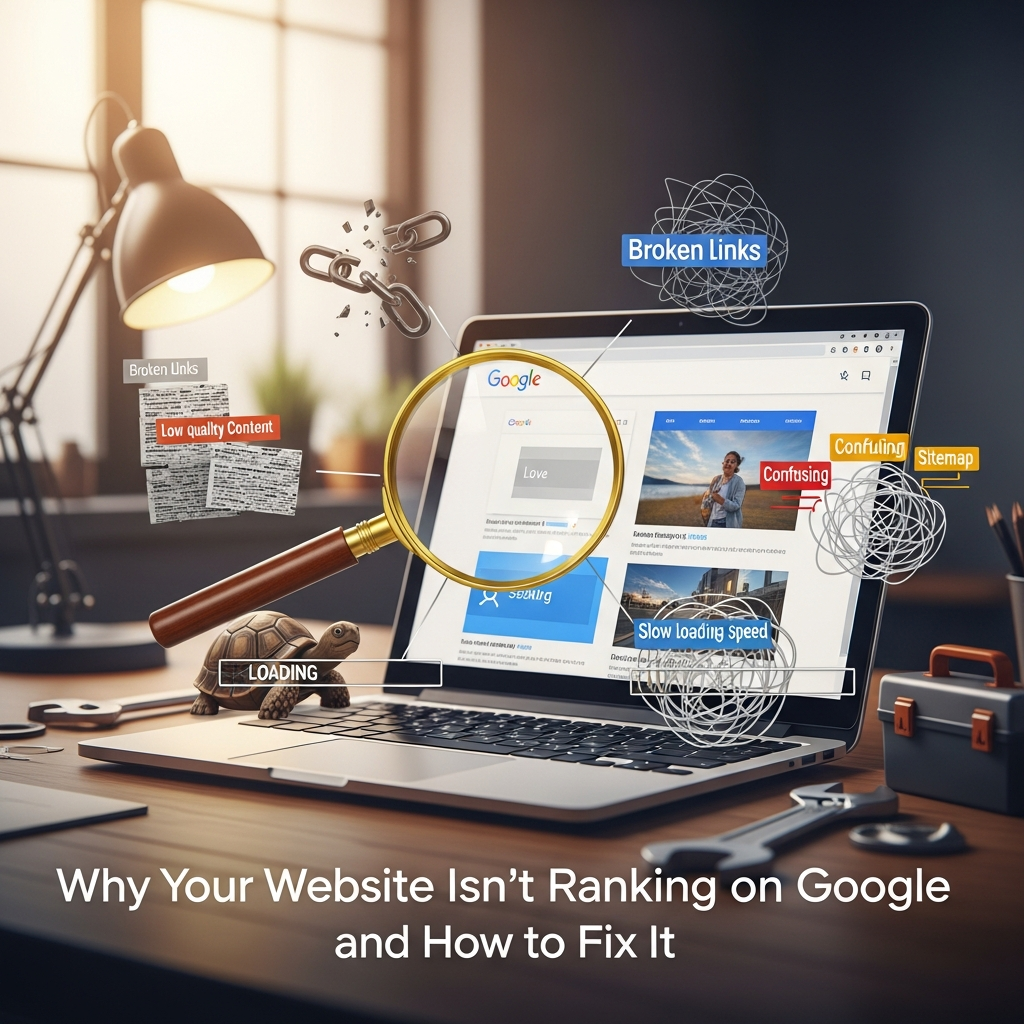
Feeling stuck because your site barely shows up in search? You are not alone. Ranking means your pages appear near the top of Google when people search. That is how you get traffic, leads, and sales.
Here is the good news. Most ranking issues have simple fixes. You do not need to be a developer or an SEO pro to see results. In this guide, you will get three parts that work together: quick checks to find the problem, fast fixes you can do today, and a 90-day plan to grow on a steady path. Stick with it and you will build consistent search visibility that compounds.
Find the Real Reason You Are Not Ranking on Google
 Photo by Atlantic Ambience
Start with a fast, focused checklist. Think of it like checking your car before a road trip.
- Indexing: Can Google find and include your pages in its results?
- Keywords and intent: Are you choosing terms you can win and matching what searchers want?
- On-page basics: Are your titles, headings, and meta descriptions set up to earn clicks?
- Mobile speed and UX: Does your site load fast and work well on a phone?
Begin with indexing. Run a site: search. Type site:yourdomain.com into Google. Do you see your pages? If not, that is your first fix. If yes, move on to keywords and intent.
Next, check your terms. Newer sites should target specific, long-tail searches. You can find ideas using free tools like the WordStream Free Keyword Tool or Keyword.io. Compare your keywords to the top results. If the page type or angle does not match, you will struggle.
Then review your on-page setup. One clear H1, a focused title tag, and a helpful meta description can lift your click-through rate. Finally, test speed and mobile usability. Slow pages lose rankings and users. Fix big images, heavy scripts, and clunky layouts, then retest.
Is Google indexing your pages? Check this first
- Search site:yourdomain.com to see what is already in Google.
- In Google Search Console, open the Indexing report. Google’s guide explains how to read it, with common reasons pages are missing. See the official Page indexing report.
- Inspect key URLs in Search Console. Look for noindex tags, blocked URLs in robots.txt, password protection, or wrong canonical tags.
- Make sure you have an XML sitemap. Submit it in Search Console.
- Fix 404s or soft 404s. Redirect them with a 301 to the best matching page.
- If you want deeper context on indexing reasons and fixes, this walkthrough helps: Google Search Console: Page Indexing Report.
Are you targeting the right keywords and search intent?
Big head terms are hard, especially for new sites. Go after longer, specific phrases that reflect real problems and clear intent. For example, “best trail running shoes for flat feet” is easier and clearer than “trail running shoes.”
Find these phrases in two places:
- Google Search Console Queries report, which shows actual searches where you get impressions.
- Free tools, like the WordStream Free Keyword Tool and Keyword.io.
Match your page to intent by checking the current top results:
- Informational: guides, how-tos, definitions.
- Comparison: versus pages, best-of lists, roundups.
- Transactional: product pages, pricing, sign-up.
If your page type does not match what ranks now, rework the content to fit.
Do your titles and meta descriptions earn the click?
The title tag and meta description sell the click. Keep them simple, clear, and tight.
- One H1 that matches the main topic.
- Title tag under 60 characters, with a benefit. Example: Trail Running Shoes for Flat Feet, Top 7 Picks Tested.
- Meta description under 160 characters, promise the answer. Example: See the best trail shoes for flat feet based on real tests, with pros, cons, and fit tips.
- Use your main keyword naturally. Skip stuffing.
- Add action words like learn, compare, review, save, or test.
Is your site mobile-friendly and fast enough?
Open your site on your phone. Can you read the text without zooming? Do buttons fit a thumb? If not, fix it.
Run Google PageSpeed Insights. Aim to improve your scores by solving:
- Large, uncompressed images.
- Render-blocking scripts and unused code.
- Heavy themes or page builders.
Core Web Vitals in plain terms:
- Load fast, Largest Contentful Paint should be quick.
- Feel smooth, keep interactions responsive.
- Stay stable, avoid layout shifts as content loads.
Quick Fixes You Can Do Today to Improve Rankings
You can make a real difference in a few hours. Focus on speed, clarity, and trust.
- Speed: compress images, reduce scripts, enable caching.
- Content: answer the main question early, then add detail.
- On-page: fix titles, headings, and internal links.
- Technical basics: HTTPS, sitemaps, clean redirects.
These are the easy wins that compound over time.
Speed up your pages in under an hour
- Compress and resize images. Use WebP where you can.
- Lazy load images below the fold so they do not block the first view.
- Remove unused plugins or apps that slow load.
- Turn on caching and minify CSS and JS with a trusted plugin or your host’s tools.
- Add a CDN if you get global traffic.
- Re-test with PageSpeed Insights. Improve the score step by step, do not chase 100.
Improve content quality and E-E-A-T
E-E-A-T means experience, expertise, authority, and trust. Show real proof.
- Add author bios with relevant experience.
- Include last updated dates on posts.
- Cite trustworthy sources where it helps readers.
- Make content scannable with headings, short paragraphs, and lists.
- Answer the main question in the first 100 words, then go deeper.
- Add an FAQ that handles related questions.
- Use original photos, screenshots, or examples when possible.
Clean up on-page SEO and user experience
- Use simple URLs, like example.com/blue-widgets.
- Add descriptive alt text to images.
- Link related pages together with helpful anchor text.
- Improve navigation. Keep menus simple, add breadcrumbs, and avoid pop-ups that block content.
- Add basic schema markup, such as Article or FAQ, if your platform supports it.
Fix technical blockers that hide your site
- Use HTTPS with a valid SSL certificate.
- Create an XML sitemap and submit it in Search Console.
- Check robots.txt for accidental blocks.
- Fix broken links. Redirect old URLs with 301s to the best match.
- Avoid redirect chains.
- Re-crawl key pages with the URL Inspection tool in Search Console after fixes.
Build Lasting SEO Growth in the Next 90 Days
Short wins help, but steady growth comes from a simple plan. Publish helpful content, earn a few quality links, and keep improving based on data.
Break the work into weekly habits, not one-off tasks. Think of it as building momentum.
Earn quality backlinks the safe way
- Create helpful guides, checklists, or tools worth referencing.
- Reach out to resource pages in your niche with a short, personal note.
- Offer quotes to journalists through press request platforms.
- Write thoughtful guest posts for relevant blogs with real audiences.
Focus on real sites with real traffic. Skip link buying. A few strong links beat dozens of low-quality ones.
Publish a simple content plan that answers real questions
Pick one topic cluster. List 8 to 12 long-tail posts that cover the main topic and common sub-questions. Post once or twice per week.
How to build the list:
- Use People Also Ask and related searches.
- Check Search Console for low-impression queries that fit your niche.
- Map each post to a clear intent and primary keyword.
- Link new posts to your main pillar page and to each other.
- Refresh older posts with new data, examples, or screenshots every few months.
Track what works and keep improving
Use Google Search Console to monitor progress:
- In Search Results, review queries, pages, and CTR.
- Improve titles and meta descriptions for pages with high impressions and low CTR.
- Watch average position for your target terms.
In analytics, track organic sessions and conversions, not just clicks. Review progress every 30 days. Keep what moves the needle, cut what does not.
Conclusion
SEO is a long game, but small steps stack up. First, find the blocker: indexing, intent, or on-page basics. Then ship quick fixes for speed, clarity, and trust. Follow a simple 90-day plan for content and links, and measure results each month. Start now, run the checks, and re-test in Search Console next week. Update one page and improve one title tag today to set your growth in motion.